
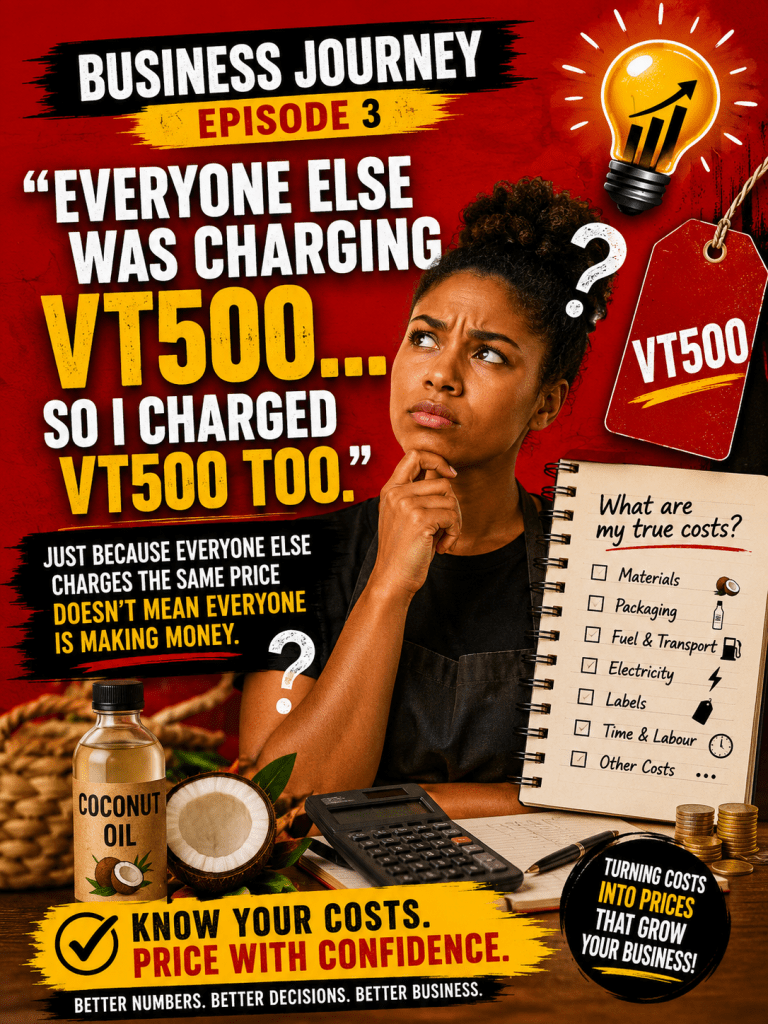
“Everyone Else Was Charging VT500… So I Charged VT500 Too.”
“Just because everyone else charges the same price doesn’t mean everyone is making money.”
Welcome Back
Last week, Sarah made an important discovery.
Her problem wasn’t that customers weren’t buying.
Her problem was that she didn’t know where her money was going.
She started writing down every sale.
She separated her business money from her household money.
For the first time, she felt more in control.
She smiled and thought,
“Now my business is finally improving.”
But a few days later, another customer asked,
“How much is one bottle?”
Without thinking, Sarah replied,
“VT500.”
The customer happily paid.
Sarah felt good.
She had made another sale.
But later that evening, while preparing more bottles, a question entered her mind.
“How did I decide on VT500?”
She couldn’t remember.
The Price That Everyone Uses
When Sarah first started selling, she looked around.
One seller charged VT500.
Another charged VT550.
Another charged VT450.
So she thought,
“I’ll just charge VT500 too.”
It seemed reasonable.
After all, everyone else was doing it.
But what Sarah didn’t know was this:
Just because someone else is charging VT500 doesn’t mean they’re making a profit.
Some businesses survive.
Some barely survive.
Some are quietly losing money with every sale.
Copying someone else’s price is like copying someone else’s answer in an exam without knowing whether it’s correct.
The Hidden Costs
Sarah believed one bottle only cost her the coconuts and the bottle.
But was that really all?
She started thinking.
She travelled to collect coconuts.
She bought fuel.
She used water.
She used electricity.
She spent hours making the oil.
She bought labels.
She bought packaging.
She used her phone to answer customers.
She paid transport to deliver orders.
Even the cloth she used for filtering needed replacing.
Suddenly she realised something.
Every bottle was carrying many small costs she had never counted.
The Biggest Mistake
Many business owners ask:
“What should I sell it for?”
Very few ask:
“What does it actually cost me to produce?”
Those are two completely different questions.
Selling price starts with understanding cost.
Not with copying competitors.
Not with guessing.
Not with hoping.
If you don’t know your cost…
You don’t know whether you’re making money.
You only know that customers are buying.
Coach’s Conversation
Imagine I asked you one simple question.
How much does it cost you to produce one of your products?
Not approximately.
Not “around.”
Not “I think.”
Exactly.
Could you answer?
Many business owners can’t.
Not because they aren’t capable.
Simply because no one has ever shown them how to calculate the true cost.
Today is the day that begins to change.
Sarah Learns About Direct Costs
Sarah started with the obvious things.
For one bottle she needed:
- Coconut oil
- Bottle
- Lid
- Label
These were easy to see.
These are called direct costs because they become part of the product.
Then she realised something else.
There were costs she couldn’t hold in her hand.
Fuel.
Electricity.
Phone credit.
Transport.
Cleaning materials.
Equipment wearing out.
Her own time.
These costs were just as real.
They simply weren’t as obvious.
A Simple Truth
Imagine baking a cake.
Would you only count the flour?
Of course not.
You would also count:
- Sugar
- Eggs
- Butter
- Gas or electricity
- Packaging
- Decorations
- Delivery
- Your time
Your product is exactly the same.
Every product carries visible costs and invisible costs.
Good business owners learn to see both.
Your Turn
Choose just one product or service that you sell.
Write its name below.
Now list everything you can think of that helps produce it.
Not just the obvious things.
Everything.
Materials:
Packaging:
Transport:
Utilities:
Time:
Other costs:
When you finish…
Ask yourself:
“Have I been charging enough?”
Coach’s Insight
One of the most common sentences I hear is:
“Customers won’t pay more.”
Sometimes that’s true.
But often it isn’t.
Many customers are willing to pay for quality, consistency, reliability, good service, attractive packaging, and trust.
The problem isn’t always the price.
Sometimes the problem is that the business owner doesn’t understand the value they are creating.
Never be afraid to calculate your costs.
The numbers are not there to discourage you.
They are there to help you make better decisions.
This Week’s Challenge
Choose one product.
Write down every single cost you can think of.
Ask yourself:
“What have I forgotten?”
Talk to another business owner.
You may discover costs you have never considered before.
Becoming a Better Business Owner
Today’s lesson wasn’t really about pricing.
It was about confidence.
When you understand your costs, you stop guessing.
You stop worrying every time someone asks,
“Why is your product more expensive?”
Instead, you can explain your price with confidence because you know the value behind it.
Confidence grows from understanding—not from copying others.
Coming Next…
Sarah had listed every cost she could think of.
She finally understood why guessing wasn’t enough.
But one question still bothered her.
She looked at her notebook and asked:
“Now that I know my costs… how do I decide on the right selling price?”
Should she add VT50?
Double the cost?
Match the market?
Or was there a smarter way?
In the next episode, you’ll discover how successful business owners turn costs into prices that keep both their customers and their businesses healthy.
 Narara Consulting
Leave a comment