
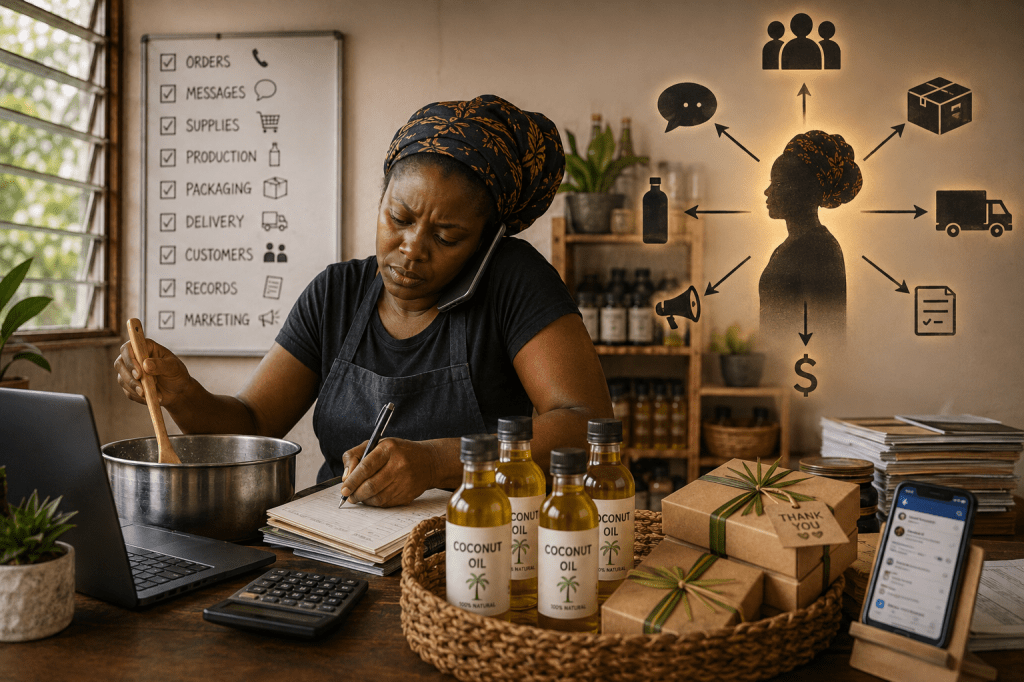
“I Was Working Harder Than Ever… But My Business Was Depending on Me for Everything.”
“A business that depends on one person can only grow as far as that one person can go.”
Welcome Back
Sarah had come a long way.
She no longer guessed her prices.
She understood her costs.
She had started separating business money from household money.
Customers were returning.
Word was spreading.
People were recommending her products.
For the first time…
She felt like she was becoming a real business owner.
But success brought something she wasn’t expecting.
More work.
Every Day Felt Like a Race
Sarah’s alarm rang before sunrise.
Before breakfast, she was already checking messages.
A customer wanted ten bottles.
Another wanted delivery.
Someone else asked if she could prepare a gift pack.
While stirring coconut oil, she answered phone calls.
While packaging products, she helped her children get ready for school.
She rushed to the market.
She bought supplies.
She delivered orders.
She replied to Facebook messages.
She washed bottles.
She prepared labels.
Late that night she finally sat down.
She was exhausted.
But there was one problem.
Tomorrow looked exactly the same.
The Business Needed Sarah for Everything
One afternoon Sarah became sick.
She thought,
“I’ll rest today.”
But almost immediately the phone started ringing.
A customer wanted to know where their order was.
Someone needed a quotation.
Another customer asked about payment.
Her cousin came to help.
She asked,
“Which bottles should I use?”
Sarah had to answer.
“Where do you keep the labels?”
Sarah had to answer.
“How much do you charge?”
Sarah had to answer.
“Which customer has already paid?”
Sarah had to answer.
Even while resting…
She was still running the business.
That evening she realised something.
She didn’t own the business.
The business owned her.
The Invisible Trap
Many small business owners believe they are independent because they work for themselves.
But ask yourself this.
If you stopped working tomorrow…
Would your business continue?
Or would everything stop with you?
If the answer is yes…
You don’t yet have a business.
You have a job that you created for yourself.
Coach’s Conversation
Imagine we were sitting together.
I’d ask you one question.
What happens in your business that only you can do?
Take a moment.
Really think about it.
Now ask another question.
Should only you be doing it?
There is a difference.
Some things require your leadership.
Many things simply require a process.
Sarah Meets Uncle Tom
One afternoon Sarah visited an older businessman named Uncle Tom.
He had owned a small bakery for many years.
She noticed something unusual.
The bakery was busy.
But Uncle Tom wasn’t rushing around.
He wasn’t baking.
He wasn’t serving customers.
He wasn’t packing bread.
Instead, he was walking around quietly, talking to staff, checking quality, greeting customers, and making decisions.
Sarah asked,
“How can you stay so calm when the shop is so busy?”
Uncle Tom smiled.
“I used to do everything myself.”
“So what changed?”
He pointed to a folder on the shelf.
Inside were simple instructions.
How to mix the dough.
How long to bake the bread.
How to clean the equipment.
How to open the shop.
How to close the shop.
How to record sales.
Then he said something Sarah wrote down immediately.
“If knowledge stays inside your head, your business can never grow beyond you.”
Systems Are Simply Good Habits Written Down
When Sarah heard the word “systems,” she imagined complicated manuals.
But Uncle Tom explained it differently.
“A system is simply the best way you’ve found to do something—written down so it can be repeated.”
That’s all.
Every successful business has systems.
Sometimes they’re written.
Sometimes they’re digital.
Sometimes they’re checklists.
But they all answer one important question.
“How do we do this every time?”
Small Systems That Make a Big Difference
Sarah didn’t need a hundred procedures.
She started with just a few.
She wrote down:
✔ How to prepare one bottle of coconut oil.
✔ How to package it.
✔ How to check the quality.
✔ How to record a sale.
✔ How to respond to customer orders.
✔ Where to store stock.
✔ What to do when supplies were running low.
Each time she repeated a task, she improved the instructions.
Slowly…
Her business became easier to manage.
Not because there was less work.
But because the work became more organised.
Your Turn
Think about one task you repeat every week.
It could be:
- Making a product.
- Serving customers.
- Recording sales.
- Cleaning equipment.
- Packing orders.
- Delivering products.
Now write the steps as if you were teaching someone else.
Step 1:
Step 2:
Step 3:
Step 4:
Could another person follow your instructions without asking questions?
If not…
Keep improving them.
Coach’s Insight
One of the biggest differences between a self-employed person and a business owner is this:
A self-employed person becomes better at doing the work.
A business owner becomes better at creating a way for the work to be done consistently.
Both work hard.
But only one is building something that can continue growing without depending entirely on them.
This Week’s Challenge
Choose one activity you repeat regularly.
Write a simple one-page instruction.
Ask someone you trust to follow it.
Don’t help them unless absolutely necessary.
Watch where they become confused.
Those confusing moments are showing you where your system needs improving.
Business Reality Check
Tick the statements that describe your business today.
☐ I do almost everything myself.
☐ If I became sick tomorrow, my business would struggle.
☐ Most of my business knowledge is in my head.
☐ I have written instructions for at least one task.
☐ Someone else could complete part of my work.
☐ I know which activities I should start delegating.
Becoming a Better Business Owner
Today’s lesson wasn’t really about writing procedures.
It was about creating freedom.
Every instruction you write down.
Every process you improve.
Every task you teach someone else…
Gives you more time to think, improve, innovate, and lead.
Businesses don’t become stronger because the owner works harder.
They become stronger because the owner builds a business that can work well—even when they’re not doing every single task.
Looking Ahead…
Sarah was finally feeling more organised.
Her business wasn’t running on memory anymore.
She had begun building simple systems.
Then something unexpected happened.
A local supermarket manager bought one bottle of her coconut oil.
The next week he called.
“Sarah, our customers like your product.”
“Can you supply 100 bottles every month?“
Sarah’s heart raced.
She had dreamed about opportunities like this.
But another thought quickly followed.
“Am I really ready for something this big?”
In our next episode, we’ll discover what happens when opportunity arrives before a business is fully prepared—and how to decide whether to say yes, not yet, or no.
 Narara Consulting
Leave a comment